Cookie Finance's

AI Assisted Ledger

COOKIE FINANCE — MAY 2026

My Role

Lead UX/Product Designer — Research, User Flows, Visual Design, Prototyping, QA

Tools

Figma, Figjam, VS Code, Jira, Github, Claude Code, Codex

Team

1 UX Designer

4 Developers

Management — CTO, CEO, VP of Product

Duration & Status

3 Months, Shipped in May 2026

Industry

Internal tools, Fintech, AI, Complex Workflows

Context

Cookie Finance provides bookkeeping and tax services for content creators, and each bookkeeper managed 100 to 200+ clients with thousands of transactions each. Their QuickBooks workflow was slow and often broke, so leadership wanted an in-house ledger powered by AI, shipped in 3 months. The catch: bookkeepers didn't trust AI and would rather do the work by hand.

How I added value

As the lead designer, I turned leadership's push for AI into a ledger bookkeepers would actually use. I designed confidence-based AI routing and AI vs. human icons so bookkeepers could always check AI's work, designed around technology constraints, and stayed on through production, leading QA and pushing fixes myself.

0 to 1

in-house AI ledger, designed and shipped in 3 months

200 hours

saved per month across the bookkeeping team

36% faster

to onboard clients onto our platform, cutting the process from 22 days to 14

0 to 1

in-house AI ledger, designed and shipped in 3 months

200 hours

saved per month across the bookkeeping team

36% faster

to onboard clients onto our platform, cutting the process from 22 days to 14

HIGHLIGHTS

An end-to-end AI assisted accounting ledger

HIGHLIGHTS

An end-to-end AI assisted accounting ledger

HIGHLIGHTS

An end-to-end AI assisted accounting ledger

0.1

COOKIE AI LEDGER WALKTHROUGH

VIDEO

0.2

transaction history recording

VIDEO

0.3

Recategorizing in Bulk

VIDEO

PROBLEM

Bookkeeping had outgrown the tools behind it

PROBLEM

Bookkeeping had outgrown the tools behind it

PROBLEM

Bookkeeping had outgrown the tools behind it

Bookkeepers were buried in transactions

Each bookkeeper managed 100 to 200+ clients, and each client could have 1,000 to 10,000+ transactions. Multiply that across a portfolio, and bookkeepers were practically buried (Figure 1.0).

1.0

thousands of transactions

IMAGE

1.0

thousands of transactions

IMAGE

1.0

thousands of transactions

IMAGE

QuickBooks was slowing them down

Most of their work happened in QuickBooks, but it often made the job harder. It could take minutes to load, disconnect bank accounts, and force bookkeepers to redo work they'd already finished (Figure 1.1).

1.1

quickbooks negative sentiment

IMAGE

1.1

quickbooks negative sentiment

IMAGE

1.1

quickbooks negative sentiment

IMAGE

Slow cleanup held up everything else

Every new client starts with a historical cleanup of their past transactions, and nothing else can start until it's done: not monthly bookkeeping, payroll, LLC setup, or taxes (Figure 1.2). As we scaled, cleanups that should take weeks could stretch into months, leaving clients paying for services they couldn't use yet.

1.2

The client lifecycle

IMAGE

1.2

The client lifecycle

IMAGE

1.2

The client lifecycle

IMAGE

THE PROBLEM

Bookkeepers couldn't clean up transactions fast enough to get new clients into the services they signed up for.

THE PROBLEM

Bookkeepers couldn't clean up transactions fast enough to get new clients into the services they signed up for.

THE PROBLEM

Bookkeepers couldn't clean up transactions fast enough to get new clients into the services they signed up for.

OPPORTUNITY

Leadership wanted a custom AI Assisted ledger

OPPORTUNITY

Leadership wanted a custom AI Assisted ledger

OPPORTUNITY

Leadership wanted a custom AI Assisted ledger

Build our own ledger, with AI inside

Leadership saw a way out: replace QuickBooks with our own ledger and use AI to categorize transactions. If AI could handle even 10% of the work, cleanups would move faster and each bookkeeper could take on more clients.

2.0

MESSAGE FROM CEO

VIDEO

A pile up of constraints...

It was a smart bet, but a big one. The ledger is where bookkeepers do their work every day, and we had to build it within two major constraints:

A three-month deadline

Leadership gave us three months to ship the ledger, which meant I had limited time for research and design iterations.

Half the wishlist

The third-party API we built on limited what was possible, so we could only build about half of bookkeepers' must-have features. (Figure 2.1)

A three-month deadline

Leadership gave us three months to ship the ledger, which meant I had limited time for research and design iterations.

Half the wishlist

The third-party API we built on limited what was possible, so we could only build about half of bookkeepers' must-have features. (Figure 2.1)

A three-month deadline

Leadership gave us three months to ship the ledger, which meant I had limited time for research and design iterations.

Half the wishlist

The third-party API we built on limited what was possible, so we could only build about half of bookkeepers' must-have features. (Figure 2.1)

2.1

Bookkeeper wishlist

IMAGE

2.1

Bookkeeper wishlist

IMAGE

2.1

Bookkeeper wishlist

IMAGE

COMPLICATION

Leadership and Bookkeepers were on opposite ends

COMPLICATION

Leadership and Bookkeepers were on opposite ends

COMPLICATION

Leadership and Bookkeepers were on opposite ends

Bookkeepers didn't trust AI

On top of those constraints, the people we were building for didn't trust what we were building. In my interviews, 4 out of 5 bookkeepers said they'd rather do the work by hand than redo AI's work. Their biggest fear: if AI got it wrong and they couldn't catch it, it would mean even more work (Figure 3.0).

3.0

Bookkeeper Quote

IMAGE

3.0

Bookkeeper Quote

IMAGE

3.0

Bookkeeper Quote

IMAGE

And they had good reason

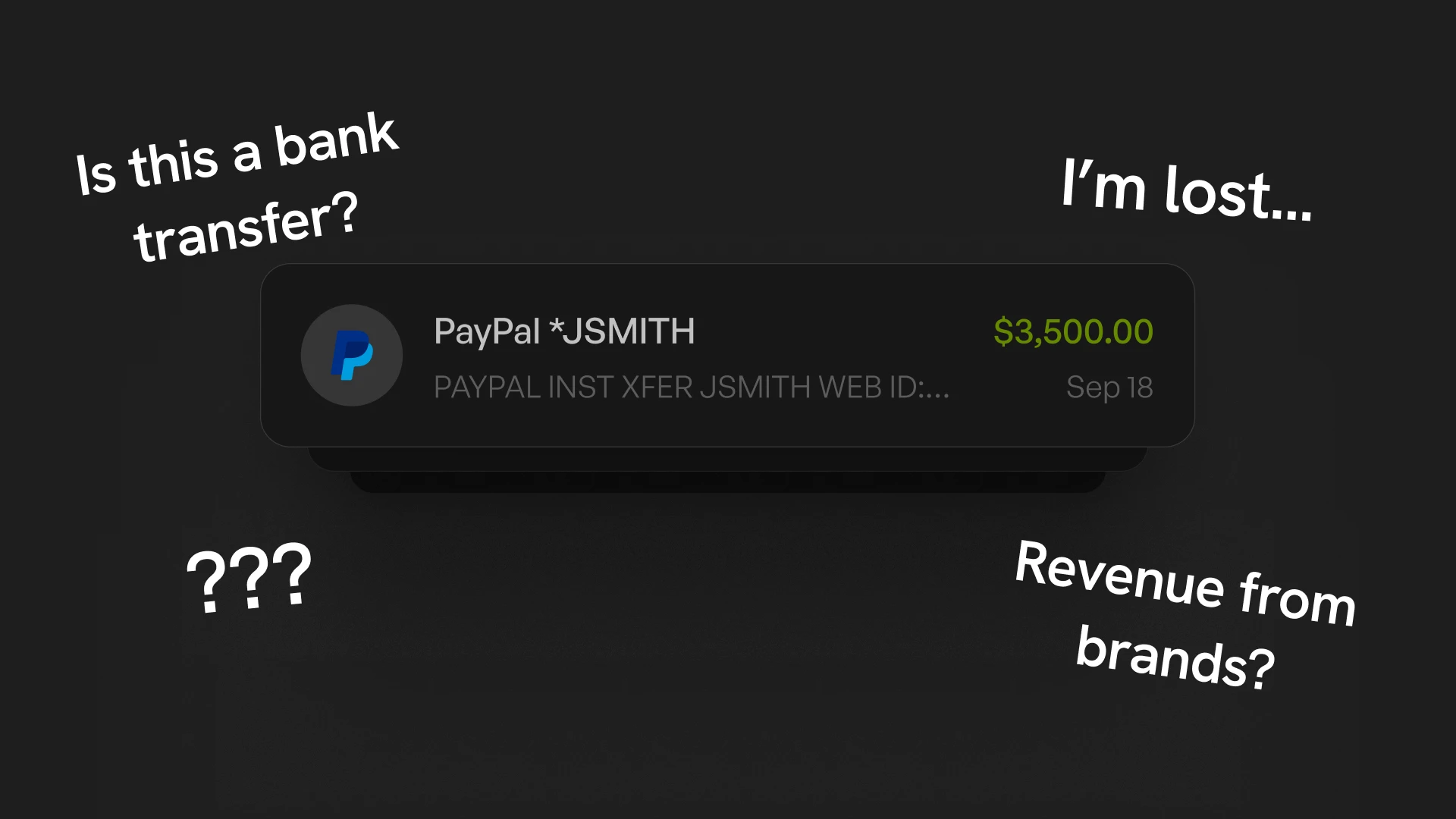
Categorization isn't as simple as it looks. Many transactions come in ambiguous, so bookkeepers categorized them using their own research and knowledge of each client. That was context AI couldn't easily see (Figure 3.1).
3.1

Ambiguous transaction

IMAGE

3.1

Ambiguous transaction

IMAGE

3.1

Ambiguous transaction

IMAGE

THE CHALLENGE

Bring AI into the ledger in a way leadership could bet on and bookkeepers would actually trust.

THE CHALLENGE

Bring AI into the ledger in a way leadership could bet on and bookkeepers would actually trust.

THE CHALLENGE

Bring AI into the ledger in a way leadership could bet on and bookkeepers would actually trust.

My guiding principles

What I learned shaped two principles that guided every decision:

Every AI decision can be checked

Bookkeepers didn't trust AI to get things right, so every AI decision had to be easy to see, review, and undo.

Keep their QuickBooks muscle memory

Bookkeepers were already hesitant about AI, so an unfamiliar interface would only add friction and slow down adoption.

Every AI decision can be checked

Bookkeepers didn't trust AI to get things right, so every AI decision had to be easy to see, review, and undo.

Keep their QuickBooks muscle memory

Bookkeepers were already hesitant about AI, so an unfamiliar interface would only add friction and slow down adoption.

Every AI decision can be checked

Bookkeepers didn't trust AI to get things right, so every AI decision had to be easy to see, review, and undo.

Keep their QuickBooks muscle memory

Bookkeepers were already hesitant about AI, so an unfamiliar interface would only add friction and slow down adoption.

solution

Instead of asking for trust, keep humans in the loop

solution

Instead of asking for trust, keep humans in the loop

solution

Instead of asking for trust, keep humans in the loop

Mapping how a transaction moves today

Before placing AI anywhere, I mapped how a transaction moves through cleanup today. Bookkeepers clean up a client's past transactions, and anything uncertain goes to Ask My Client (AMC) for more context. It then gets recategorized and finally lands in Categorized (Figure 4.0).

4.0

transaction lifecycle

IMAGE

4.0

transaction lifecycle

IMAGE

4.0

transaction lifecycle

IMAGE

Placing AI where people can check it

I placed AI inside that same flow based on confidence, so it never skips a checkpoint. Low-confidence transactions surface at the start of cleanup, so bookkeepers catch them early. High-confidence ones (70%+) go straight to Categorized, where they can still be reviewed and corrected (Figure 4.1).

Highlight Human Review

4.1

TRANSACTION LIFECYCLE WITH AI

IMAGE

Highlight Human Review

4.1

TRANSACTION LIFECYCLE WITH AI

IMAGE

Highlight Human Review

4.1

TRANSACTION LIFECYCLE WITH AI

IMAGE

THE SOLUTION

The problem wasn't AI. It was AI that bookkeepers couldn't see or correct.

THE SOLUTION

The problem wasn't AI. It was AI that bookkeepers couldn't see or correct.

THE SOLUTION

The problem wasn't AI. It was AI that bookkeepers couldn't see or correct.

UI Breakdown

Designing for trust, one decision at a time

UI Breakdown

Designing for trust, one decision at a time

UI Breakdown

Designing for trust, one decision at a time

A layout built for thousands of rows

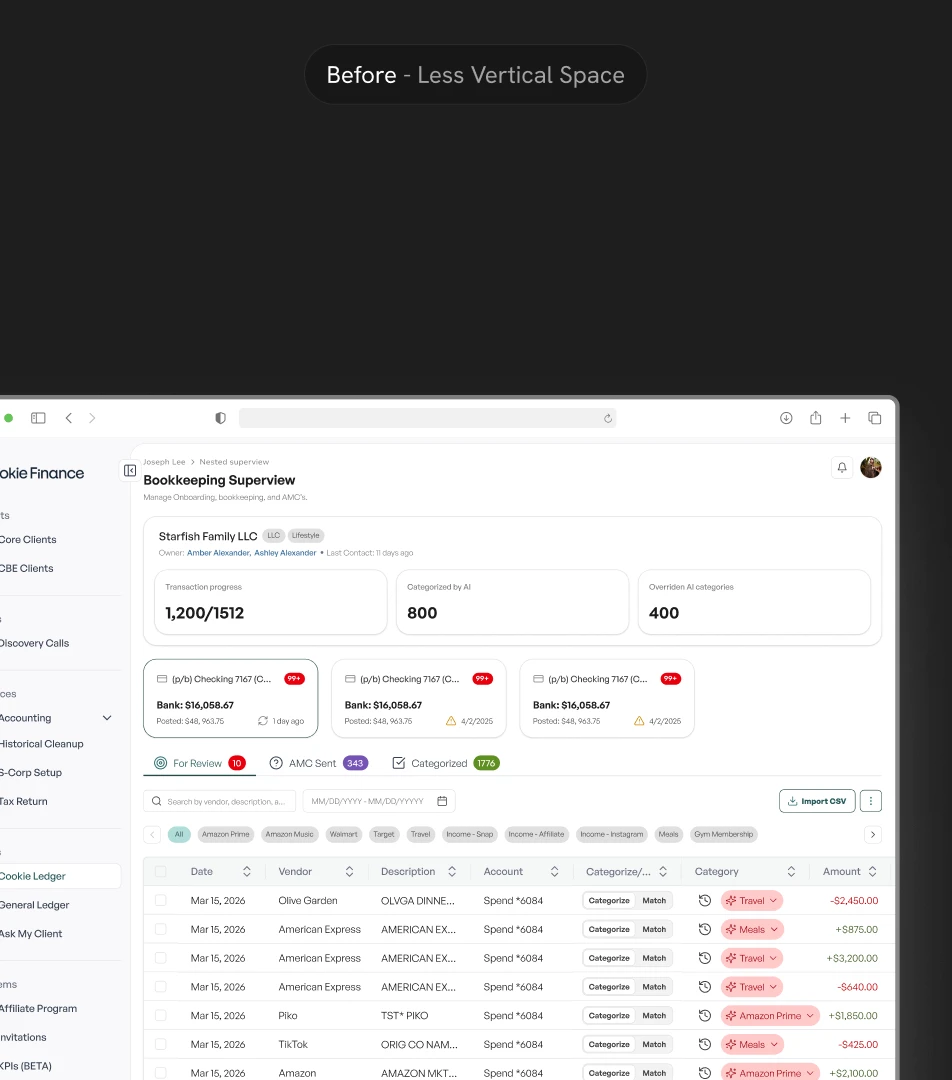
I explored two layouts, and bookkeepers pushed back on the first. Layout B gave them far more vertical space, which matters when scrolling through thousands of transactions (Figures 5.0 and 5.1).
Show Design Annotations

5.0

Layout A Breakdown

IMAGE

Show Design Annotations

5.1

Layout B Breakdown

IMAGE

Show Design Annotations

5.0

Layout A Breakdown

IMAGE

Show Design Annotations

5.1

Layout B Breakdown

IMAGE

Tabs that mirror the workflow

I turned the cleanup flow into tabs, so bookkeepers always know where a transaction stands and how far along they are in each client's cleanup (Figure 5.2).

5.2

BOOKKEEPING WORKFLOW TO TABS

IMAGE

5.2

BOOKKEEPING WORKFLOW TO TABS

IMAGE

5.2

BOOKKEEPING WORKFLOW TO TABS

IMAGE

Showing who touched what

I first proposed a hover state explaining why the AI chose a category, like showing your work in math class (Figure 5.3). Engineering couldn't support AI reasoning yet, so I scoped it down to icons marking whether AI or a person categorized each transaction, and kept reasoning as a future goal (Figure 5.4).

Show Design Annotations

5.3

Proposed: AI with Reasoning

IMAGE

Show Design Annotations

5.4

Shipped: AI vs Human Icons

IMAGE

Show Design Annotations

5.3

Proposed: AI with Reasoning

IMAGE

Show Design Annotations

5.4

Shipped: AI vs Human Icons

IMAGE

An audit trail on every transaction

Bookkeepers' biggest request was a clear history. Clicking into any transaction shows who categorized it and when, keeping both AI and teammates accountable (Figure 5.5).

5.5

Transaction History

IMAGE

5.5

Transaction History

IMAGE

5.5

Transaction History

IMAGE

Bulk actions for bulk volume

One-by-one editing doesn't work with thousands of transactions. I designed bulk tools to confirm, recategorize, and reassign vendors (Figure 5.6), and added bulk splitting, a heavily requested feature that didn't exist before (Figure 5.7).

5.6

Bulk Actions

IMAGE

5.6

Bulk Actions

IMAGE

5.6

Bulk Actions

IMAGE

Bringing Ask My Client into the ledger

QuickBooks had no AMC feature, so bookkeepers copied transactions into spreadsheets and emailed clients, and transactions often got lost (Figure 5.8). I built the AMC lifecycle into the ledger, with Creator Accountants owning client communication (Figure 5.9).

5.7

'Ask My Client' In Ledger

IMAGE

5.7

'Ask My Client' In Ledger

IMAGE

5.7

'Ask My Client' In Ledger

IMAGE

Final Designs

From handoff to production

Final Designs

From handoff to production

Final Designs

From handoff to production

Staying with it through QA

After handoff, I led design QA with bookkeepers to make sure every flow worked the way we designed it. I pushed small UI and logic fixes myself, and worked through bigger architectural issues on calls with developers (Figure 6.1).

Staying with it through QA

After handoff, I led design QA with bookkeepers to make sure every flow worked the way we designed it. I pushed small UI and logic fixes myself, and worked through bigger architectural issues on calls with developers (Figure 6.1).

6.0

AI LEDGER WALKTHROUGH

VIDEO

6.1

transaction history recording

VIDEO

6.2

Bulk recategorization Recording

VIDEO

Launch

Bookkeepers felt the difference

Launch

Bookkeepers felt the difference

Launch

Bookkeepers felt the difference

A strong first response

The ledger saved 200 hours per month and made client onboarding 36% faster. Bookkeepers called it easy to understand, one categorized 170 transactions in a single click, and another walked over to our desks to say it was a massive improvement (Figure 7.0).

A strong first response

The ledger saved 200 hours per month and made client onboarding 36% faster. Bookkeepers called it easy to understand, one categorized 170 transactions in a single click, and another walked over to our desks to say it was a massive improvement (Figure 7.0).

7.0

COMMENT ON AI LEDGER

IMAGE

7.0

COMMENT ON AI LEDGER

IMAGE

7.0

COMMENT ON AI LEDGER

IMAGE

7.1

AI LEDGER DATA REPORT

IMAGE

7.1

AI LEDGER DATA REPORT

IMAGE

7.1

AI LEDGER DATA REPORT

IMAGE

Retrospective

Designing AI people actually trust

Retrospective

Designing AI people actually trust

Retrospective

Designing AI people actually trust

Looking back...

This project was challenging in every way, but I learned a lot from it:

Looking back...

This project was challenging in every way, but I learned a lot from it:

Trust is shaped by design

Bookkeepers only used AI they could see, check, and undo. Designing for trust is something I now bring into everything I work on.

Trust is shaped by design

Bookkeepers only used AI they could see, check, and undo. Designing for trust is something I now bring into everything I work on.

Trust is shaped by design

Bookkeepers only used AI they could see, check, and undo. Designing for trust is something I now bring into everything I work on.

Trust is shaped by design

Bookkeepers only used AI they could see, check, and undo. Designing for trust is something I now bring into everything I work on.

Don't reinvent the wheel

Bookkeepers were already adjusting to AI, so building on their QuickBooks muscle memory reduced friction and helped them adopt the ledger quickly.

Don't reinvent the wheel

Bookkeepers were already adjusting to AI, so building on their QuickBooks muscle memory reduced friction and helped them adopt the ledger quickly.

Don't reinvent the wheel

Bookkeepers were already adjusting to AI, so building on their QuickBooks muscle memory reduced friction and helped them adopt the ledger quickly.

Don't reinvent the wheel

Bookkeepers were already adjusting to AI, so building on their QuickBooks muscle memory reduced friction and helped them adopt the ledger quickly.

What I'd do next

If I had the chance, I'd go back and design the features the API couldn't support, starting with AI reasoning on hover. There's still a lot of room to improve the bookkeeping experience there.

What I'd do next

If I had the chance, I'd go back and design the features the API couldn't support, starting with AI reasoning on hover. There's still a lot of room to improve the bookkeeping experience there.

What I'd do next

If I had the chance, I'd go back and design the features the API couldn't support, starting with AI reasoning on hover. There's still a lot of room to improve the bookkeeping experience there.

What I'd do next

If I had the chance, I'd go back and design the features the API couldn't support, starting with AI reasoning on hover. There's still a lot of room to improve the bookkeeping experience there.

Thanks for reading

Check out more Cool Projects

© 2026 All rights reserved

© 2026 All rights reserved

Portfolio made with <3

Portfolio made with <3